
 SEARCH
 LOGIN
LOGIN  BLOG
BLOG
 CART
CARTProduct successfully added to your shopping cart
There are 0 items in your cart. There is 1 item in your cart.
Multifactor Leadership Questionnaire™
Authors: Bernard M. Bass & Bruce J. Avolio
The Multifactor Leadership Questionnaire™ (MLQ—also known as MLQ 5X short or the standard MLQ) measures a broad range of leadership types from passive leaders, to leaders who give contingent rewards to followers, to leaders who transform their followers into becoming leaders themselves. The MLQ identifies the characteristics of a transformational leader and helps individuals discover how they measure up in their own eyes and in the eyes of those with whom they work. Success can be measured through a retesting program to track changes in leadership style. The program described in the MLQ Trainer's Guide provides a solid base for leadership training.
MLQ products are used for either assessment/development and for research.
- If you are using the MLQ for research, click here for a list of MLQ products designed for researchers.
- If you are using the MLQ for assessment and development, click here for a list of MLQ products designed for consultants.
Authentic Leadership Questionnaire: Measures the components that comprise Authentic Leadership: self awareness, transparency, ethical/moral behavior, and balanced processing.
Leader Efficacy Questionnaire: Based on Leader Self and Means Efficacy Theory, the LEQ is unique because it captures both leaders' self-efficacy, as well as leaders' beliefs in the extent that those with whom they interact will support their leadership.
Multifactor Leadership Questionnaire + Authentic Leadership Questionnaire: Combines the ALQ and MLQ surveys so you can conduct a single survey on Transform™ rather than two separate surveys.
Organizational Description Questionnaire: Measures how often each member of the organization perceives the culture of their unit, department, or organization, to be using transformational or transactional leadership styles.
Team Multifactor Leadership Questionnaire: Assesses the leadership style of a team. It represents an extension of transforming leadership definitions from the individual to the collective.
Copyright © 1995 by Bernard Bass & Bruce J. Avolio. "Full Range Leadership" ® is a Registered Trademark of Bernard Bass & Bruce J. Avolio
Multifactor Leadership Questionnaire™ is a trademark of Mind Garden, Inc.
- Buy It
- Sample Items
- Product Specs
- Translations
- Resources
- FAQ
- Manual$50.00Includes details on reliability, validity, etc. and a review-only copy of the MLQ. PDFs are not refundable.In Stock
- MLQ II 360 Suite$125.00Suite includes the MLQII 360 Leader's Report, Executive Summary, and Leader's Workbook.In Stock
- MLQ II 360 Leader's Report$100.00Builds a report that interprets and compares ratings of an individual to their self-rating. You invite participants to take the survey and Transform™ generates their reports.In Stock
- MLQ II 360 Leader's Report with Authentic Leadership Styles$125.00Builds a report that interprets and compares others' ratings of an individual to their self-rating on both the Multifactor Leadership Questionnaire (MLQ) and the Authentic Leadership Questionnaire (ALQ). You invite participants to take the survey and Transform™ generates their reports.In Stock
- Individual Report: Actual vs. Ought (MLQ II)$20.00Builds a report that interprets an individual's MLQ Actual vs. Ought scores. You invite participants to take the survey and Transform™ generates their reports.In Stock
- Report About Me: Actual vs. Ought (MLQ II)$25.00Interprets and reports on your MLQ Actual vs. Ought scores. You complete the survey and Transform™ generates your report. Transform will connect this report to the "Send To" email provided at checkout. Note: This product is for a single use, with automated survey administration. For multiple uses, buy instead the Individual Report product in quantity needed.In Stock
- Individual Report: Self Form$15.00Builds a report that interprets an individual's MLQ Self Form scores. You invite participants to take the survey and Transform™ generates their reports.In Stock
- Report About Me: Self Form$20.00Interprets and reports on your MLQ Self Form scores. You complete the survey and Transform™ generates your report. Transform will connect this report to the "Send To" email provided at checkout. Note: This product is for a single use, with automated survey administration. For multiple uses, buy instead the Individual Report product in quantity needed.In Stock
- Group Report: Self Form$200.00Builds a report that calculates and summarizes average MLQ Self Form scores for a group of participants.In Stock
- Group Report: Rater Only$200.00Builds a report that calculates and summarizes average MLQ Rater Form scores for a group of participants.In Stock
- Group Report: MLQ II 360 Suite$200.00Builds a report that calculates and summarizes average MLQ 360 Suite scores for a group of participants.In Stock
- Group Report: Multi-rater Form (MLQ II)$200.00Builds a report that calculates and summarizes average MLQ Multi-rater scores for a group of participants.In Stock
- Transform Survey Hosting: Multi-rater Form (MLQ II)$11.00Minimum purchase of 10. Minimum purchase quantity 10 enables you to invite 10 participants, plus their raters, to the 360-style MLQ assessment. Online administration via our Transform™ system includes data collection with raw scale scores by participant and rater. Customization services are available.In Stock
- Transform Survey Hosting: Self Form (Data)$2.75Minimum purchase of 20. Allows you to administer the MLQ Self Form as an online survey using Mind Garden's Transform™ System. Includes data collection: data file with participants' raw data and raw scale scores. Optionally, Individual Reports and Group Reports can be generated from the collected data - requires the purchase of report licenses. Customization services are available.In Stock
- Transform Survey Hosting: Rater Form (Data)$2.75Minimum purchase of 20. Allows you to administer the MLQ Rater Form as an online survey using Mind Garden's Transform™ System. Includes data collection: data file with participants' raw data and raw scale scores. Optionally, Group Reports can be generated from the collected data - requires the purchase of report licenses. Customization services are available.In Stock
- License to Administer$2.75Minimum purchase of 50. Allows you to administer the MLQ as an online survey via a non-Mind Garden survey system or as a paper and pencil survey. The downloadable PDF file includes one copy of the MLQ Leader and Rater forms, scoring key, and permission to administer the MLQ up to the quantity purchased. The PDF is non-refundable.In Stock
- Leader's Workbook$15.00This workbook complements the MLQ 360 Leader's Report and contains developmental behaviors for each MLQ scale and item.In Stock
- Trainer's Guide$150.00Resource tool designed to aid the trainer in developing a workshop for teaching the Full Range Leadership model and for how to use the MLQ to create positive behavioral change. Second Edition.In Stock


















Features of the MLQ
Purpose: Measure, explain, and demonstrate the key factors that set truly exceptional leaders apart from marginal ones.
Length:
MLQ Multi-rater Form, Rater Only Form, and Self Only Form = 45 items
MLQ Actual/Ought Form = 90 items
Average completion time:
MLQ Multi-rater Form, Rater Only Form, and Self Only Form = 15 minutes
MLQ Actual/Ought Form = 25-30 minutes
Target population: Adults
Administration: For individual or group administration
Other MLQ Features:
a. Differentiates effective and ineffective leaders at all organizational levels.
b. Assesses the effectiveness of an entire organization's leadership.
c. Valid across cultures and types of organizations.
d. Extensively researched and validated.
e. The MLQ provides an excellent relationship between survey data and organizational outcome.
Uses of the MLQ
- Leadership development
- Leadership research
The Authentic Leadership Questionnaire - available in combination with the MLQ - measures the components that comprise authentic leadership. The MLQ identifies effective leadership types, however highly transformational leaders can be highly effective without being authentic (e.g. Hitler). Using the ALQ alongside the MLQ provides measurement of leaders' self awareness, transparency, ethics/morality, and balanced processing.
Scales
Transformational Leadership:
Builds Trust (Idealized Attributes)
Acts with Integrity (Idealized Behaviors)
Encourages Others (Inspirational Motivation)
Encourages Innovative Thinking (Intellectual Stimulation)
Coaches & Develops People (Individualized Consideration)
Transactional Leadership
Rewards Achievement (Contingent Reward)
Monitors Deviations & Mistakes (Management-by-Exception: Active)
Passive/Avoidant
Fights Fires (Management-by-Exception: Passive)
Avoids Involvement (Laissez-Faire)
Outcomes of Leadership
Generates Extra Effort
Is Productive (Effectiveness)
Generates Satisfaction
If you are unable to find the translation you need, you can request permission to make a translation.
Available with MLQ Transform™ Survey Hosting:
Regardless of which translation you select, participants can select and change any of these languages while taking the survey.
MLQ Multi-rater Form
- Czech
- French
- German
- Italian
- Norwegian
- Portuguese
- Russian
- Spanish
- Turkish
MLQ Self Only Form
- Czech
- French
- German
- Italian
- Portuguese
- Russian
- Spanish
- Turkish
MLQ Rater Only Form
- German
- Turkish
MLQ Actual/Ought Form
- Spanish
MLQ Suite Report
- Norwegian
Available with MLQ License to Administer:
These translations are available free of charge with your purchase of the license. Translations are provided in a separate pdf-format file. Select the language from the Translation drop-down list. Need multiple translations? Contact us.
- Albanian
- Arabic
- Bulgarian - Leader Form only
- Burmese--Myanmar - Rater Form only
- Chinese-Cantonese
- Chinese-Mandarin
- Creole-Papiamentu
- Croatian - Rater Form only
- Czech
- Danish - Rater (partial*) Form only (*only Transformational & Transactional items)
- Dutch - Rater Form only
- Estonian
- Farsi
- Finnish
- French
- German
- Greek
- Hebrew - Rater Form only
- Hungarian - Leader Form only
- Icelandic
- Indonesian
- Italian
- Japanese
- Kazakh
- Korean
- Laotian - Leader Form only
- Lithuanian
- Malay
- Norwegian
- Polish
- Portuguese
- Romanian
- Russian
- Serbian
- Slovenian
- Spanish
- Swahili - Leader Form only
- Swedish
- Tagalog
- Thai
- Turkish
- Urdu
- Vietnamese
Note: We cannot assure translation quality — many are made by individual researchers and we are not necessarily familiar with the particular language or dialect. Some of the translations are partial and typically do not have validation data. Basically, we offer whatever is available to facilitate your work.
Need help organizing and analyzing your data? We recommend Statistics Solutions, a team of Ph.D research methodologists and statisticians who specialize in psychological survey instruments, research design, data analysis, etc. Click here to contact Statistics Solutions.
Molly Breysse Cox, MA, PhD candidate
Contact: mollyb9@uw.edu
Molly has over 20 years of change management work experience with Fortune 500 companies. This includes leadership positions in IT, Operations, Customer Service, Product Management, and Marketing. She joined the CLST team in 2013 as a leadership development coach and member of the CLST Game Team. Molly’s currently in a CLST faculty and leadership associate position working in master programs such as Technology MBA and Hybrid MBA and Jackson School of International Studies.
Molly has a BA from the University of Washington, a MA from Antioch’s Center for Creative Leadership and she is currently is completing her PhD dissertation in Antioch’s Leadership and Change program. Her dissertation is an examination of an individual’s motivation and ability to trust in the workplace.
Molly has a broad range of experience in transformational change projects including designing and deploying new technology, designing organizational change and leadership development, and strategic planning. In addition she was chosen in 2008 as the recipient of Women in Technology International’s Leadership Award for leadership in support of women in IT.
Jesse Calloway, CEC, PhD
Contact: info@leadershiplmc.com
Jesse is president of Leadership & Motivation Consultants LLC and an adjunct faculty member of Batten College of Engineering & Technology at Old Dominion University, where he received a PhD in Engineering Management. Jesse is a proven and experienced former executive, a certified executive coach, and winner of the prestigious TMCF Corporate Leadership Award.
With 25+ years of leadership experience, Jesse designed an enterprise-wide leadership development program. He offers comprehensive training, assessments, and coaching, incorporating Full Range Leadership Theory, with emphasis on practical and contingent leadership applications. Jesse has lived through every aspect of instruction that he offers and his client base includes academic, federal, non-profit and corporate settings.
Jesse has published three titles on leadership, leveraging skills, concepts, and strategies gained during the author’s rise from blue-collar worker to corporate executive, which include key business and research topics and leadership theory.
Helen Chung, PhD
Contact: helenchung@spu.edu
Helen Chung teaches management for the School of Business, Government, and Economics at Seattle Pacific University. She completed her PhD in Industrial and Organizational Psychology, and her areas of interest include leadership, coaching for leadership development, and storytelling. In addition to teaching, Helen is an independent coach and consultant, working with clients who seek to build their leadership capacity and effectiveness.
Joey A. Collins, Psy. D.
Contact: drjoey@uw.edu
Joey A. Collins, Psy.D., teaches in the Industrial-Organizational Psychology graduate program at Seattle Pacific University (SPU) and is a founding member of the Center for Leadership Research & Development (CLR&D) at SPU. The CLR&D serves individuals and organizations by: (1) creating research-based tools, resources, and processes to help leaders learn and grow in real time; (2) establishing strategic partnerships with other leaders, experts, networks, and clearing houses; and (3) training a cadre of highly skilled leaders, researchers, and leadership development practitioners. Joey collaborates with the Center for Leadership and Strategic Thinking in various engagements.
Joey is a leadership development consultant specializing in executive coaching, leadership and organization development. His clients include Veterans Health Administration, General Motors, Maritz, Coinstar-Redbox, UW Medical Center -Harborview, Seattle Zoo, and Smith Gardens.
He served as a Post-Doctoral Fellow for two years with the VHA National Center for Organization Development delivering a variety of OD interventions to VA Medical Centers and Program Offices throughout the United States. He also completed his Psychology Internship at Loma Linda VA and a one-year Psychology Practicum at the VA Los Angeles Ambulatory Care Center. Joey is also a licensed Clinical Psychologist in Washington State. He received his Psy.D. in Clinical Psychology from BIOLA University.
Donna J. Dennis, PhD
Contact : donna@leadership-solutions.info
Donna is a leadership coach and consultant who has utilized transformational leadership principles in training design and delivery since 1993. She uses the MLQ to assist Leadership and Development professionals with their delivery of key leadership concepts and principles. Her clients include C.R. Bard, Chubb and Son, Inc., The University of Pennsylvania Hospital, RCA and GE. Donna has teaching experience with The Wharton Business School and the University of Pennsylvania. She is Co-Director of Leadership for the Gestalt International Study Center. Recent MLQ projects include coaching a Superintendent of Schools and his staff; assisting a Pharmaceutical VP of R&D transition to a new role requiring greater speed to market; and providing a start-up management team with training and feedback.
Donna has a PhD in Human Development with an emphasis in Adult Development from Fielding Graduate University, with undergraduate and Master’s degrees from University of Illinois. She has coaching certification from Stakeholder-Based Coaching, Marshall Goldsmith, Positive Psychology (Martin Seligman), Gestalt International Study Center, Bernie Bass & Bruce Avolio, and a Professional Coach (PCC) level certification from International Coach Federation.
Dan Eisenman
Contact: eisendan@uw.edu
Dan Eisenman is an executive coach, facilitator and consultant who has over 27 years of leadership and training experience in healthcare, the military, retail, and insurance industries. For 10 years Dan has aided physicians and staff in critical care environments and healthcare administration in hospital and clinical environments, centering on leadership skill and effective interpersonal communication. With leadership experience as a military officer and as a retail manager, along with 15 years in the insurance industry, he has a broad perspective. Dan is a Certified Performance Improvement consultant with extensive experience building high performance teams. He is certified as a Leadership Coach and works with leaders at all levels. Most recently Dan operated as an executive coach for Catholic Health Initiatives’ Transformative Leader Development Program and managed leader development programs for CHI Franciscan in Tacoma, Washington.
Louis Forbringer, PhD
Contact: forbrl@uw.edu
Louis (Lou) Forbringer is a consultant with over 30 years of experience working with organizations in the areas of leadership development, executive coaching, succession planning, organization development, culture change and change management. His clients have included Mirage Resorts, Laclede Gas, Edward Jones, Lord Corp., Federal Reserve Bank of St Louis, American Bankers’ Association, US Bank, DRS Technologies, BP America, KeyCorp, and Catholic Health Initiatives. Lou served as the Vice President of Organizational Talent Management at Catholic Health Initiatives (2008-2014).
Lou received his Ph.D. and MA in Industrial/Organizational psychology from the University of Akron and his BA in Psychology from Allegheny College.
In addition to his work with CLST, he is an adjunct professor of Health Care Leadership at George Washington University, School of Medicine and Health Sciences. Previously, he was adjunct faculty at the Olin School of Business (1996-2008) teaching Leadership and Change Management in the MBA and Executive MBA programs and at Maryville University, teaching graduate courses in Leadership and Organizational Behavior. Lou has served on the Society of Human Resources Management (SHRM) Foundation Board as its President and also served as a Director on the Human Resources Certification Institute (HRCI) board and as a Director on the board of the American Banker's Association. He has been a member of the editorial board of the Human Resource Management Journal and an ad hoc reviewer for Personnel Psychology.
Matthew Jones, PhD
Contact: matt@nwemergent.com
Matthew is an interdisciplinary consultant with a zest for good leadership and effective organizations. He helps organizations solve problems and improve operations, and has served as a consultant on small and large projects including: leadership development programming/training, executive coaching, organizational assessments, and meeting facilitation.
Matthew uses a scientific approach but is also well recognized for his human relations skills. His approach integrates transformational leadership, emotional intelligence, and empathic thinking. Matthew works alongside clients, providing recommendations and co-creating solutions that are appropriate and useful for the organization and community.
He has authored numerous publications in leadership, organizational development, and statistics. Matthew earned a PhD from Portland State University, where he trained as a quantitative organizational specialist. He has held academic appointments at State University of New York, Brockport College and Portland State University.
Kurt O’Brien
Contact: kcobrien44@gmail.com
Kurt holds a faculty position as a senior lecturer with the University of Washington’s Department of Health Services Master in Healthcare Administration program, and is also an independent consultant. He has over twenty years of experience in the field of organization development and eighteen years of direct leadership experience; his passion is for helping leaders more fully develop their leadership craft.
Kurt specializes in the areas of leadership development and coaching, interpersonal skills development, team development, strategic planning, and conflict resolution. Additionally, he designs and conducts workshops on topics such as adaptive leadership, leading change, emotional intelligence, dialogue, and conflict resolution.
Kurt was with University of Washington (UW) Medicine for fifteen years, including seven as the director of Organization Development and Training, where he worked with leaders and teams from the executive level to those providing care directly at the bedside. Prior to joining the UW he spent twelve years as an active duty officer in the U.S. Coast Guard.
Kurt received his Master’s in Human Resources and Organization Development (MHROD) from the University of San Francisco in 1997. He recently co-authored a book for healthcare leaders titled, Leading Adaptive Teams in Healthcare Organizations, and has written or contributed to various articles. Kurt is often invited to speak at conferences on a range of leadership topics.
Kurt lives in Poulsbo, WA on the Kitsap Peninsula with his wife and golden retriever, where they enjoy hiking, kayaking, and traveling.
Lisa Orlick-Salka
Contact: lisa@lisaorlick.net
Lisa Orlick is an executive coach and a writer, who brings more than twenty-five years’ experience working with leaders, assisting them to confront complex challenges, while building resilience. Her signature approach employs the best practices of creative learning by incorporating emotional intelligence and design thinking. She has coached leaders in the financial services, software, healthcare, energy, arts, as well as the non-profit sector.
Lisa is a graduate of University of Pennsylvania where she earned a Masters in City Planning and Bachelor of Arts in Urban Studies. She received coaching certification from the Hudson Institute of Santa Barbara, and is credentialed by the International Coaching Federation.
Lisa began her career as an urban planner working overseas researching alternative energy management strategies, then moved into strategic planning for small businesses and non-profits, before pursuing executive coaching. Her interdisciplinary problem solving approach is informed by expertise in varying contexts including, public-private partnerships, small and large businesses, international NGOs, and the arts. In addition to coaching, Lisa serves on an international advisory board for a social justice organization and is a trustee for a Seattle-based non-profit.
Sarah Osteen, MBA
Contact: sarah@sparkstrategyllc.com
Sarah Osteen is a leadership consultant focused on organization effectiveness consulting, leadership program design and delivery, and executive coaching. Clients span a range of sectors including: financial, energy, public sector, pharmaceutical, health care, technology, retail, and non-profit.
Sarah received her BA in English from Georgetown University and her MBA from the F.W. Olin Graduate School of Business at Babson College. In 2012 Sarah attended the Executive Coaching Intensive Program at Columbia University and has effectively leveraged her coaching skills as part of robust leadership development programs.
Sarah spent nine years as a Senior Solutions Manager in Corporate Learning at Harvard Business Publishing. In her role she worked closely with the Harvard Business Publishing sales team to design powerful leadership development solutions and to help drive the six million in annual revenue for the North East. Sarah continues to maintain a close partnership with Harvard Business Publishing in the role of Moderator and Senior Instructional Designer. Sarah partners with the University of Washington Foster School of Business Center for Leadership and Strategic Thinking to provide executive coaching and facilitation. You can listen to Sarah interview experts around the topics of influence and power on her podcast Swayed available on iTunes.
Chuck Pratt
Contact: ceepratt@uw.edu
Chuck Pratt is an independent consultant, trainer, personal coach and a former member of the U. S. Coast Guard where he was a successful organizational leader for 23 years. Coast Guard career highlights include command of two ships; Chief of Professional Development at the Coast Guard Academy where he directed leadership training for cadets; and adjunct instructor for both the Coast Guard’s Leadership Development Center and the Academy’s Leadership and Management Department.
Chuck is a 1979 graduate of the Coast Guard Academy, he has a B.S. in Management and an M.S. in Instructional Technology from Utah State University.
Chuck works on teambuilding, leadership development, coaching, interpersonal skills training, conflict management, emotional intelligence, appreciative inquiry, group facilitation and dialogue. He has consulted with organizations for more than 25 years, and taught interpersonal skills and leadership training to nearly 20,000 learners. He has worked with such diverse groups as adult learners, business, government and non-profits, intact work teams, college students, public school teachers, parents, and at-risk high school students.
Diane Vreyens
Contact: vreyens@uw.edu
Diane Vreyens is a coach, consultant and facilitator who specializes in accelerating the development of leaders and teams to perform highly in complex and globally diverse environments. She's known for her ability to create safe and supportive learning environments that foster creativity, curiosity, and growth. With extensive international experience, having lived and worked for 13+ years in Asia, Europe, and the Middle East, Diane brings deep cross-cultural competence and a keen ability to bridge multiple perspectives.
Diane has an MS in organization development from American University, a post-graduate certificate in leadership coaching from Georgetown University, and is certified as a professional leadership coach by the International Coach Federation. She also has an undergraduate degree and advanced formal training in intercultural communication.
Over a span of more than 25 years, Diane has both consulted to and held internal roles at a variety of organizations in the corporate, non-profit, government, and educational sectors. Some of the organizations she has worked with include Procter and Gamble, GE Capital, the HJ Heinz Company, Craft Brew Alliance, the League of Conservation Voters, University of Washington Center for Leadership and Strategic Thinking, and UW Medicine health system.
Janet Williams Hepler, MA
Contact: jwh@highlinecoaching.com
Janet Williams Hepler is a professional coach who works with leaders to explore their strengths and identify their path to become leaders who motivate teams and work across organizations to achieve exceptional results. Janet has coached individuals at all levels—from emerging leaders to the C-Suite.
Janet has earned master’s degrees in French and in Industrial Organizational Psychology. She is a professional coach certified by the International Coaching Federation. Janet serves on the Board of the Puget Sound Chapter of the Association for Talent Development (ATD).
In addition to working with individuals, Janet also works has worked with teams in corporate and non-profit organizations to build stronger working relationships that result in greater clarity on the mission, and increased capacity to achieve objectives and adapt to change. Janet draws from over 20 years of experience in technology companies where she learned how to work and lead in innovative organizations. She led teams that learned to adapt to continuous change.
Avolio, B. J. (1999). Full leadership development: Building the vital forces in organizations. Thousand Oaks, CA: Sage.
Avolio, B. J. (2005). Leadership development in balance: Made/born. NJ: Erlbaum & Associates.
Avolio, B. J. (2011). Full range leadership development (2nd ed.). Thousand Oaks, CA: SAGE.
Avolio, B. J. & Bass, B. M. (2002). Developing potential across a full range of leadership: Cases on transactional and transformational leadership. Mahwah, NJ: Lawrence Erlbaum Associates.
Avolio, B. J., & Luthans, F. (2006). High impact leader: Moments matter in authentic leadership development. NY: McGraw-Hill.
Bass, B. M. (1985). Leadership and performance beyond expectations. New York: Free Press.
Bass, B. M. (1990). Bass & Stogdill's handbook of leadership: Theory, research, and managerial applications. New York: Free Press.
Bass, B. M. (1998). Transformational leadership: Individual, military and educational impact. Mahwah, NJ: Erlbaum.
Bass B. M. & Avolio, B. J. (Eds.). (1994). Improving organizational effectiveness through transformational leadership. Thousand Oaks, CA: Sage.
Bass, B. M. & Bass, R. (2008). The Bass handbook of leadership (4th ed.). New York: Free Press.
Bass, B. M. & Riggio, R. E. (2005). Transformational leadership (2nd ed.). Mahwah, NJ: Lawrence Erlbaum Associates.
Riggio, R. E. (2020). Daily Leadership Development: 365 Steps to Becoming a Better Leader. Barnes & Noble.
Sosik, J. J. (2015). Leading with character: Stories of valor and virtue and the principles they teach (2nd ed.). Charlotte, NC: Information Age Publishing.
Sosik, J. J. & Jung, D. I. (2018). Full range leadership development: Pathways for people, profit and planet (2nd ed.). New York: Routledge.
Antonakis, J., Avolio B. J., & Sivasubramaniam, N. (2003). Context and leadership: an examination of the nine-factor full-range leadership theory using the Multifactor Leadership Questionnaire. The Leadership Quarterly, 14(3), 261-295.
Avolio, B. J., Bass, B. M., & Jung, D. (1999). Reexamining the components of transformational and transactional leadership using the Multifactor Leadership Questionnaire. Journal of Occupational and Organizational Psychology, 7, 441-462.
Barling, J., Weber, J., & Kelloway, E. K. (1996). Effects of transformational leadership training on attitudinal and financial outcomes: A field experiment. Journal of Applied Psychology, 81, 827-832.
Bass, B. M. (1997). Does the transactional-transformational leadership paradigm transcend organizational and national boundaries? American Psychologist, 52(2),130-139.
Bass, B. M., Avolio, B. J., Jung, D. I. & Berson, Y. (2003). Predicting unit performance by assessing transformational and transactional leadership. Journal of Applied Psychology, 88(2), 207-218.
Balthazard, P. A., Waldman, D. A., Thatcher, R. W., & Hannah, S.T. (2012). Differentiating transformational and non-transformational leaders on the basis of neurological imaging. The Leadership Quarterly, 23(2), 244-258.
Block, L. (2003). The leadership-culture connection: An exploratory investigation. Leadership & Organizational Development Journal, 24(6). 318-334.
Bono, J. E., Hooper, A. C., & Yoon, D. J. (2012). Impact of rater personality on transformational and transactional leadership ratings. The Leadership Quarterly, 23(1), 132-145.
Breevart, K., Bakker, A. B., Demerouti, E., Sleebos, D. M., & Maduro, V. (2014). Uncovering the underlying relationship between transformational leaders and followers’ task performance. Journal of Personnel Psychology, 13(4), 194-203.
Brown, D.J. & Keeping, L.M. (2005). Elaborating the construct of transformational leadership: The role of affect. The Leadership Quarterly, 16(2), 245-272.
Dvir, T., Eden, D., Avolio, B. J.,& Shamir, B. (2002). Impact of transformational leadership on follower development and performance: A field experiment. Academy of Management Journal, 45, 735-744.
Eagly, A. H. Johannesen-Schmidt, M. C., & Van Engen, M. L. (2003). Transformational, transactional, and laissez-faire leadership styles : A meta-analysis comparing women and men. Psychological Bulletin 129, 4, 569-591.
Eisenbeiss, S. A., van Knippenberg, D., & Boerner, S. (2008). Transformational leadership and team innovation: Integrating team climate principles. Journal of Applied Psychology, 93, 1438-1446.
Hamstra, M. R. W., Van Yperen, N. W., Wisse, B., & Sassenberg, K. (2011). Transformational-transactional leadership styles and followers’ regulatory focus: Fit reduces followers’ turnover intentions. Journal of Personnel Psychology, 10(4), 182-186.
Hinkin, T. R. & Schrieshiem, C. A. (2008). An examination of 'nonleadership': From laissez-faire leadership to leader reward omission and punishment omission. Journal of Applied Psychology, 93, 1234-1248.
Hinkin, T. R. & Schriesheim, C. A. (2008). A theoretical and empirical examination of the transactional and non-leadership dimensions of the Multifactor Leadership Questionnaire. The Leadership Quarterly, 19(5), 501-513.
Howell, J. M., & Avolio, B. J. (1993). Transformational leadership, transactional leadership, locus of control, and support for innovation: Key predictors of consolidated business business-unit performance. Journal of Applied Psychology, 78, 891–902.
Johnson, A. M., Vernon, P. A., Harris, J. A., Jang, K. L. (2004). A behavior genetic investigation of the relationship between leadership and personality. Twin Research, 7(1), 27-32.
Judge, T. A., & Piccolo, R. F. (2004). Transformational and transactional leadership: A meta-analytic test of their relative validity. Journal of Applied Psychology, 89 (5), 755-768.
Kovjanic, S., Schuh, S. C., Jonas, K., Van Quaquebeke, N., & Van Dick, R. (2012). How do transformational leaders foster positive employee outcomes? A self‐determination‐based analysis of employees' needs as mediating links. Journal of Organizational Behavior, 33, 1031-1052.
Li, C. & Shi, K. (2003). Transformational leadership and its relationship with leader effectiveness. Psychological Science (China), 26(1), 115-117.
Pieterse, A. N., Van Knippenberg, D., Schippers, M., & Stam, D. (2010). Transformational and transactional leadership and innovative behavior: The moderating role of psychological empowerment. Journal of Organizational Behavior, 31, 609-623.
Zarandi, A., Ghorbani, N., Alavi, S. B. (2012). Relationship between five-factor of personality and transformational leadership based on the other-appraisal of subordinates & super ordinates. Psychological Research, 14 (2), 96 - 111.
Zhu, W., Avolio, B. J., Riggio, R. E., Sosik, J. J. (2011). The effects of transformational leadership on follower and group ethics. The Leadership Quarterly,10, 801-817.
Rowold, J. (2005). Mutifactor Leadership Questionnaire: Psychometric properties of the German translation by Jens Rowold. Menlo Park, CA: Mind Garden.
American Psychological Association press release reports that the MLQ predicts leadership in battlefield simulations. See "Leadership Styles That Use Rewards and Shared Values Help Platoons Perform Well in Simulated Combat Situations: Implications for Leadership Training in the Military" at the American Psychological Association (3/26/03).
How transformational leadership works: Kaiser, Robert B. and Robert Hogan and S. Bartholomew Craig (2008). "Leadership and the fate of organizations." American Psychologist, 63(2) 96-110.
"Research on how leaders affect followers' self-concepts indicates that transformational leadership works by influencing followers to identify with a collective enterprise and to internalize group aspirations. Transactional leadership appeals to followers' self-interest, but transformational leadership changes the way followers see themselves—from isolated individuals to members of a larger group. Transformational leaders do this by modeling collective commitment (e.g., through self-sacrifice and the use of “we” instead of “I”), emphasizing the similarity of group members, and reinforcing collective goals, shared values, and common interests. When followers see themselves as members of a collective, they tend to endorse group values and goals, and this enhances their motivation to contribute to the greater good."
Research findings on transformational leadership from "Context and leadership: an examination of the nine-factor full-range leadership theory using the Multifactor Leadership Questionnaire" by John Antonakis, Bruce J. Avolio and Nagaraj Sivasubramaniam, The Leadership Quarterly, 14(3), June 2003, 261-295:
- Transformational leaders created greater alignment around strategic visions and missions.
- Transformational leadership behavior factors are associated with organizational sales increases, market share, earnings and ROI.
- Scores on Transformational leadership predict individual and group performance.
- Transformational leadership has been found to explain between 45% and 60% of organizational performance.
- Transformational leaders created greater unit cohesion, commitment, and lower turnover.
- Transformational leadership predicted higher levels of product innovation in R & D teams.
- Transformational leaders created safer work environments.
- Transformational leadership training has been shown to improve leadership and associated performance over time.
Featured
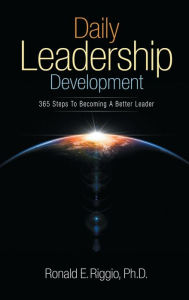
Ronald Riggio (2020). Daily Leadership Development: 365 Steps to Becoming a Better Leader. Barnes & Noble.
Daily Leadership Development is a leadership development guidebook that offers day-by-day instruction in "bite-sized chunks," covering all aspects of leadership and leader development. It is thoroughly grounded in research and best practices and is written by one of the nation's foremost experts on leadership. It is accessible and conversational and each day's topic covers a specific aspect of leadership and offers practical tips for personal development. There are also several self-assessments to evaluate your leadership strengths, style, and areas for development.
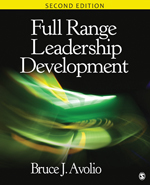
Bruce J. Avolio (2011). Full Range Leadership Development (2nd ed.). Sage.
A practical guide to leadership development based on the world's most thoroughly researched leadership development model.
Conversational and accessible, this Second Edition of Bruce J. Avolio's groundbreaking book uses the full range leadership development model as an organizing framework and shows how it can be directly applied to improving leadership at the individual, team, and organizational levels. Filled with examples that show how the full range model comes to life in today's global world, Full Range Leadership Development, Second Edition, demonstrates how people, timing, resources, the context of interaction, and expected results in performance and motivation all contribute to effective leadership.
Over the two decades, the full range model has become the most researched model in the leadership literature — and the most validated—and has been proven to be an accurate guide for developing exemplary leadership in diverse cultures, organizations, and leadership positions. The new edition shows how the process of leadership development is linked to validation and how the process of validation informs accelerated leadership development.
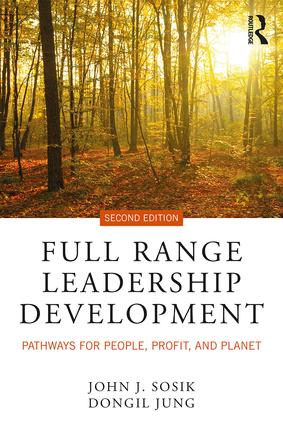
John J. Sosik and Dongil Jung (2018). Full Range Leadership Development: Pathways for People, Profit and Planet (2nd ed.). Routledge.
It has been more than 30 years since Bernard M. Bass presented an integrated overview of Full Range Leadership Development (FRLD), which has since become the standard for providing leadership training around the world in business, military, religious, and educational contexts. This book teaches how to use FRLD to grow transformational leaders in organizations. Organizations that support and develop transformational leadership at all levels are more productive and profitable, attract and retain top notch talent, promote creativity and innovation, garner trust and commitment from employees, leverage sustainability and workplace safety efforts, and are strategically positioned to respond well to uncertainties and changes in the market.
Retaining the conversational style of the first edition, this second edition contains several new features, such as: updated leader profiles and leadership examples, including more international cases; expanded discussion of gender diversity and leadership in teams; and new Summary Questions and Reflective Exercises.
The book’s practical action steps make it of use to both practitioners and students and well-suited as a core leadership textbook or supplement in leadership development courses.
Transformational leaders are those who transform their followers into becoming leaders themselves. From Wikipedia, "Transformational leadership is a leadership approach that is defined as leadership that creates valuable and positive change in the followers. A transformational leader focuses on "transforming" others to help each other, to look out for each other, to be encouraging and harmonious, and to look out for the organization as a whole. In this leadership, the leader enhances the motivation, morale and performance of his follower group." From Bass and Riggio (2006, page 3), "Transformational leaders are those who stimulate and inspire followers to both achieve extraordinary outcomes and, in the process, develop their own leadership capacity. Transformational leaders help followers grow and develop into leaders by responding to individual followers' needs by empowering them and by aligning the objectives and goals of the individual followers, the leader, the group, and the larger organization. Evidence has accumulated to demonstrate that transformational leadership can move followers to exceed expected performance, as well as lead to high levels of follower satisfaction and commitment to the group and organization." There are four components of Transformational Leadership (Bass, Bernard M. 1998 Transformational Leadership. New York: Lawrence Erlbaum Assoc, Inc.):
Builds Trust and Acts with Integrity (Idealized Influence - also known as Charismatic Leadership) - Transformational leaders act in ways that make them role models. They are respected, admired and trusted. Followers identify with them and describe them in terms that imply extraordinary capabilities, persistence and determination. These leaders are willing to take risk. They can consistently be relied upon to do the right thing, displaying high moral and ethical standards.
Encourages Others (Inspirational Motivation) - These leaders embody the term "team spirit". They show enthusiasm and optimism, providing both meaning and challenge to the work at hand. They create an atmosphere of commitment to goals and a shared vision.
Encourages Innovative Thinking (Intellectual Stimulation) - a Transformational Leader encourages creativity and fosters an atmosphere in which followers feel compelled to think about old problems in a new way. Public criticism is avoided.
Coaches & Develops People (Individualized Consideration) - Transformational leaders act as mentors and coaches. Individual desires and needs are respected. Differences are accepted and two-way communication is common. These leaders are considered to be good listeners, and along with this comes personalized interaction. Followers of these leaders move continually toward development of higher levels of potential.
The term Transformational Leadership was introduced in 1978 by James MacGregor Burns in his analysis of political leaders. His conclusions centered around the differences between management and leadership. He communicated the two basic concepts of "transformational" and "transactional" leadership.
In 1985, Bernard M. Bass added to Burns' theory on Transformational Leadership, and in the early 1990's Bass and Bruce Avolio, through empirical study, mapped the most common leadership approaches of managers and military commanders. They placed Transformational and Transactional Leadership on a continuum and defined more stages at the passage between the two leadership approaches. This model is called "The full range of leadership."
While researching these concepts, the Multifactor Leadership Questionnaire (MLQ) (Bass & Avolio) was used. The MLQ measures the concepts of transformational and transactional leadership. The MLQ has undergone various revisions over the years and had achieved a set of items that are clear, behaviorally based, and so central to the concepts that there are only four items per concept (scale) and yet the MLQ consistently shows excellent validity and prediction of organizational performance.
- Bernard Bass, besides being known as a father of Transformational Leadership, is also the author of the famous Bass & Stogdill's Handbook of Leadership. In developing the MLQ he used his deep knowledge about leadership and what predicts organizational performance.
- The MLQ has become the benchmark measure of Transformational Leadership.
- The MLQ measures, and the MLQ report makes personal to individuals how they relate on the key factors that set truly exceptional leaders apart from marginal ones.
- Valid across cultures and all types of organizations (see Bass 1997).
- Easy to administer, requires 15 minutes for a rater to complete the 45 questions.
- Extensively researched and validated, documented in numerous journal articles and independent studies.
- Among leadership assessment methods, the MLQ provides the best relationship of "survey data" to "organizational outcome"
The classic form (MLQ 5X Short) of the MLQ includes both self and rater forms. The self form measures self perception of leadership behaviors. The rater form is used to measure leadership as perceived by people at a higher level, same level, or lower level in the organization than the leader. Each form is 45 questions. The ideal number of raters for a leader is 8-10, with at least 3 in the subordinate category. The MLQ also includes 9 outcome items rating the leader's effectiveness and the satisfaction the rater has for the leader. The rater form is at the heart of the MLQ and may be used without the leader form if desired. The leader form serves to provide a contrast between how the leader perceives herself and how others perceive her. Validity is documented for the rater form, however there is no relationship between a leader's self-rating and organizational performance.
The MLQ, in its measurement of Transformational and Transactional Leadership, reflects on leadership behavior. It provides a contrast between how the leader sees himself versus how others see him. The perceptions of others form critical feedback to the leader and provide specific information to that leader to provide a basis for growth and change. Frequently, the MLQ is administered before and after leadership training programs to focus the training and to measure the effect of these programs.
The MLQ has been translated into dozens of languages and is used all over the world for the measurement of Transformational Leadership. Transformational leaders may be found in any culture.
For additional FAQs about the MLQ and other multi-rater instruments, please visit our FAQ pages.