Impact Message Inventory – Kreismodell (IMI)
Autor: Donald J. Kiesler
Das Impact Message Inventory - Kreismodell (IMI) hilft beim Klären zwischenmenschlicher Interaktion in jeder Art von Dyaden (z.B. Freunde, Lehrer-Student, Arbeitgeber-Arbeitnehmer, Therapeut-Klient, Arzt-Patient). Das Inventar bietet eine innovative Methode zum Messen interpersonalen Verhaltens, indem die Handlungstendenzen und Gefühle erfasst werden, welche die zu beurteilende Person bei der Person auslöst, die den Fragebogen ausfüllt: Dominanz, Feindseligkeit, Unterwürfigkeit, und Freundlichkeit. Das IMI ist geeignet für den Gebrauch mit älteren Adoleszenten und Erwachsenen.
Das IMI ist ein Selbst-Einschätzungs-Inventar, das dazu geschaffen ist, das interpersonale Verhalten einer Zielperson zu erfassen. Zugrunde liegt die Auffassung, dass das interpersonale Verhalten bzw. Sender-Verhalten einer Person A valide definiert und erfasst werden kann, indem die nicht sichtbaren Reaktionen oder „impact messages“ (etwa: eintreffenden Botschaften) bei einer anderen Person B erfasst werden, die mit Person A interagiert oder sie beobachtet hat.
Das IMI wird benutzt, um das zwischenmenschliche Verhalten von normal oder schlecht adaptierten Menschen zu erfassen, indem die Konsequenzen ihres Verhaltens in der Interaktion mit anderen erfasst werden. Es sondiert dabei die automatisierten, relativ wenig bewussten emotionalen und anderen verdeckten Reaktionsmuster, die wir anderen gegenüber haben. Das IMI ist gleichzeitig ein Selbst- und eine Fremdbeurteilungsmessmittel, das erste Messmittel dieser Art.
Copyright 2006 by Donald J. Kiesler
Eigenschaften des IMI
Zweck: Messung der Handlungstendenzen und Emotionen, welche die zu beurteilende Person bei der ausfüllenden Person auslöst
Länge: 56 Fragen
Durchschnittliche Bearbeitungsdauer: 10-15 Minuten
Zielpopulation: 16 und älter (beurteilende und beurteilte Person)
Verwendung: individuell oder in Gruppen
Nutzung des IMI
- Studien zu Psychotherapeut-Patienten-Dyaden
- Studien zu fehlangepassten Patientengruppen
- Studien zu Therapeut-Supervisor-Dyaden und „parallelen Prozessen“
- Interpersonale Studien zur Persönlichkeits- und Gesundheitspsychologie
- Interpersonale Studien zu Arzt-Patienten-Dyaden
Skalen
Das IMI erfasst acht Kategorien von zwischenmenschlichem Verhalten, die gleichabständig um den interpersonalen Kreis herum angeordnet sind. Die acht Skalen sind, oben begonnen und im Gegenuhrzeigersinn:
Dominant
(DOM) Feindselig-Dominant
(HOS-DOM) Feindselig
(HOS) Feindselig-Submissiv
(HOS-SUB) Submissiv
(SUB) Freundlich-Submissiv
(FRI-SUB) Freundlich
(FRI) Freundlich-Dominant
(FRI-DOM) | 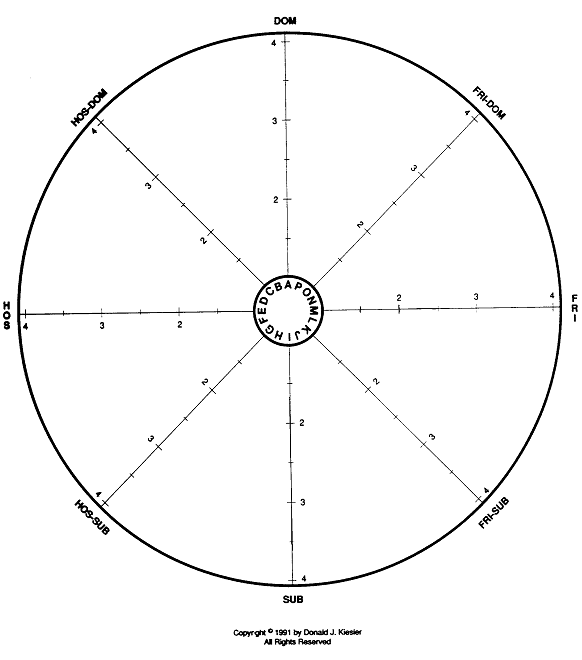 |
Herunterladen des deutschen IMI:
IMI Deutsch (pdf) Kostenlos
s. dazu:
Caspar, F., Berger, T., Fingerle, H., Werner, M. (2016). IMI-D. Die deutsche Version des Impact Message Inventory (IMI) Psychotherapie im Dialog 17(04): 9 (Kurzversion) Langversion: Psychotherapie im Dialog 17(04): e1–e11.
F. Caspar, F., Fingerle, H., Werner, M. (2016). IMI Impact Message Inventory. In: Geue, K., Strauß, B., & Brähler, E. (Hrsg.). Diagnostische Verfahren in der Psychotherapie (3. Aufl.), S. 280-283. Göttingen: Hogrefe.
Homepage with Information for the German Translation: imi.psy.unibe.ch
Das IMI kann ohne Weiteres nach dem Auswertungsschlüssel auf der MindGarden- Homepage ausgewertet werden. Von Fangmeier wurde zusätzlich ein kostenloses Auswertungsprogramm entwickelt, das auch eine grafische Darstellung produziert. Zugang ist über imi.psy.unibe.ch möglich.
Adjective Check List Assesses personality traits with a full sphere of descriptive adjectives. The ACL provides a convenient, standardized method for recording and generating meaning for personal attributes of an individual. The ACL form can be used for self or observer ratings and Transform provides self or multi-rater assessment and reporting.
Body Insight Scale Measures awareness of internal and external bodily sensations that support comfort, health, and overall well-being.
Chapin Social Insight Test Assess the perceptiveness and accuracy with which an individual can appraise others and forecast what they might say and do.
Enright Forgiveness Inventory An objective measure of the degree to which a person forgives another person, group or entity that has hurt him or her deeply and unfairly.
Personality Adjective Check List The PACL is a 153-item self-report and rating measure of Theodore Millon's eight basic personality patterns for use with normal adults and counseling or psychotherapy clients.
Personality Disorder Adjective Check List A brief screening measure for the assessment of personality disorders. It consists of 175 adjectives and adjectival phrases the client uses to describe their attributes.
Psychological Distress Profile A brief and effective measure of four common domains of psychological distress: Depression, Hopelessness, Anxiety, and Anger.

 SEARCH
 LOGIN
LOGIN  BLOG
BLOG
 CART
CART